Case Study
De Leon Street & Solary Canal
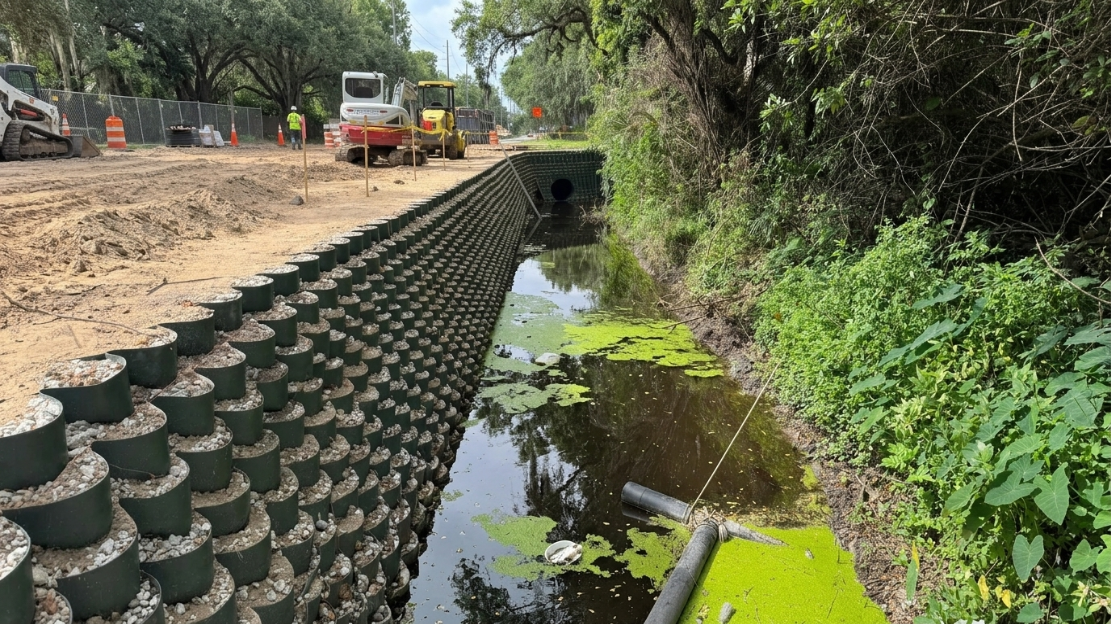
GEOWEB® retaining wall system stabilizes a constrained Seminole County conveyance channel.
Project Overview
Retaining Wall
Conveyance Channel
Soil Stabilization
Presto GEOWEB® Wall
Solmax Mirafi® 2XT

Along the De Leon Street and Solary Canal corridor, R. H. Moore & Associates, a Nexterra company, supported a retaining wall solution designed to stabilize the channel edge, protect adjacent infrastructure, and perform within a constrained drainage environment.
The project team selected a Presto Geosystems GEOWEB® retaining wall system reinforced with Solmax Mirafi® 2XT geogrid to create a flexible, durable earth retention solution suited for conveyance channel conditions. GEOWEB retaining walls are engineered to maintain structural integrity in challenging base conditions, support stormwater infiltration, conform to site contours, and install more efficiently than many traditional MSE block wall systems.
The project reflects the type of technically demanding infrastructure work supported by R. H. Moore, a Nexterra company, delivering geosynthetic expertise, constructable solutions, and long-term performance across drainage, transportation, and civil infrastructure applications.
THE CHALLENGE
A Constrained Canal Corridor Requiring Reliable Edge Stabilization
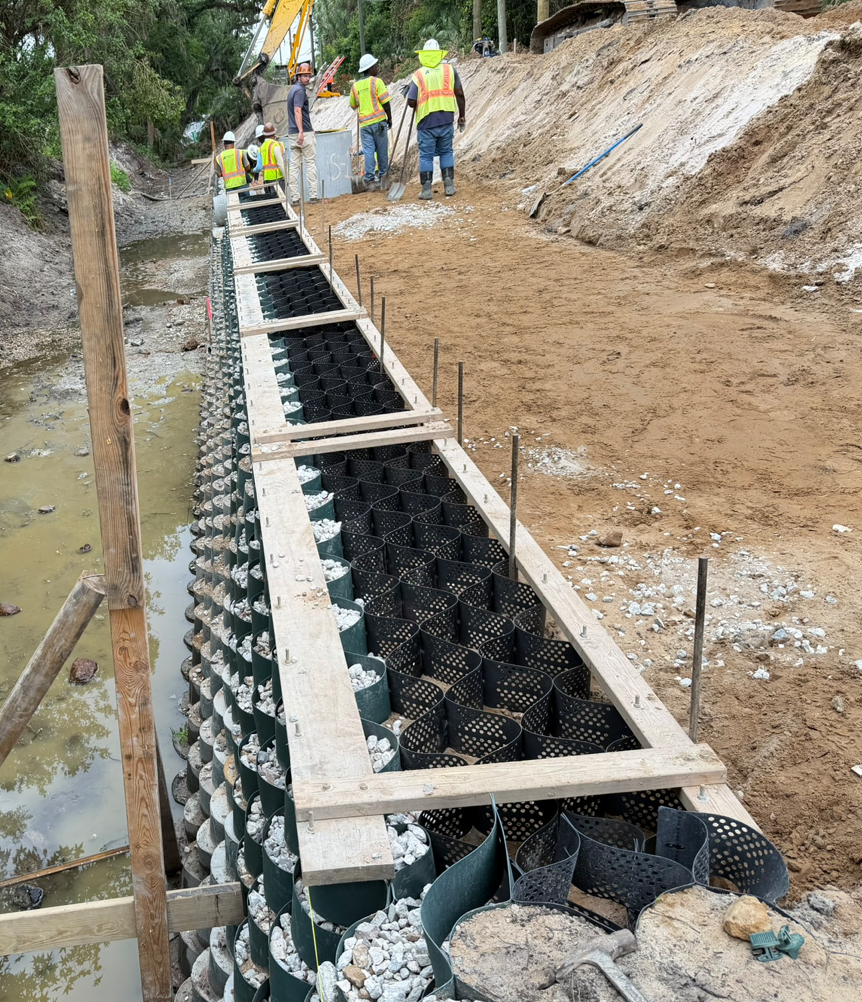
The De Leon Street and Solary Canal project presented a demanding combination of limited work space, channel-side construction, soft and variable soil conditions, and long-term durability requirements within a moisture-prone drainage environment.
The retaining wall system needed to stabilize the canal edge while supporting nearby roadway infrastructure and maintaining performance where settlement, drainage, and constructability all mattered.
Rigid retaining systems can be difficult to install in narrow corridors and may be less forgiving where subsurface conditions vary. Seminole County needed a solution that balanced structural support with flexibility, drainage performance, and practical field installation.
For R. H. Moore, a Nexterra company, the project represented a strong example of the complex site constraints often encountered across municipal stormwater and conveyance infrastructure work.
THE SOLUTION
A Flexible GEOWEB® Retaining Wall Reinforced with Mirafi® 2XT
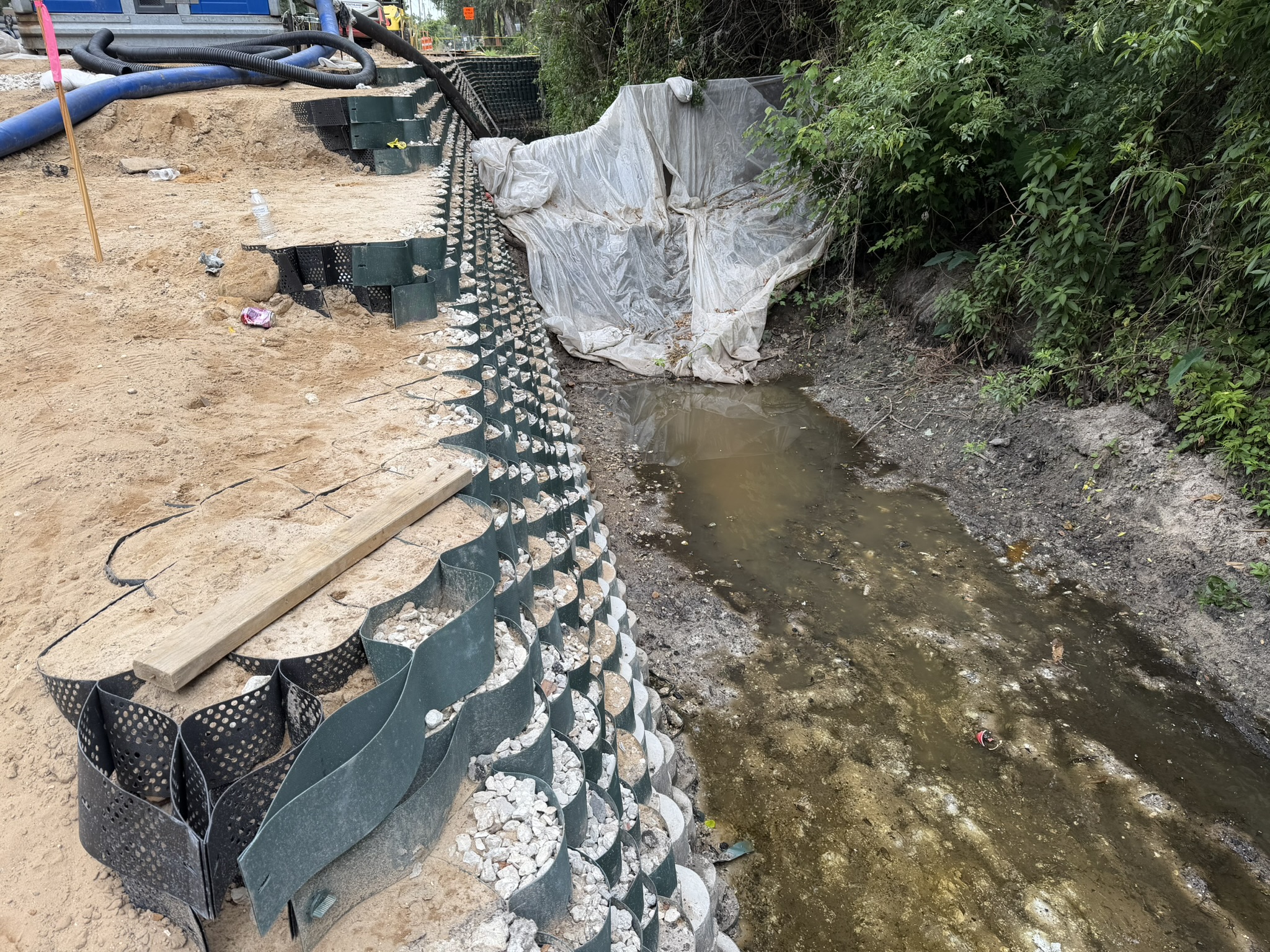
The project team implemented a Presto Geosystems GEOWEB® cellular confinement retaining wall system reinforced with Solmax Mirafi® 2XT geogrid. The open-cell wall structure provided confinement for infill material while the geogrid reinforcement strengthened the reinforced soil mass behind the wall.
1. Flexible Wall Performance
The GEOWEB wall system was well suited for variable site conditions because the cellular confinement structure can tolerate differential settlement more effectively than many rigid wall systems.
2. Reinforced Soil Support
Mirafi® 2XT geogrid was incorporated to provide soil reinforcement for the retaining wall structure and support overall stability along the channel corridor.
3. Drainage-Friendly Design
The permeable wall face helps reduce hydrostatic pressure concerns by allowing water movement through the wall system rather than trapping water behind a rigid structure.
4. Constructable in a Tight Corridor
Lightweight modular GEOWEB sections helped simplify installation along the canal, where access, staging, and equipment movement were limited.
Outcome
The completed wall delivered a reinforced earth retention solution for the De Leon Street and Solary Canal corridor while addressing the practical realities of channel-side construction.
Stabilized Channel Edge
The reinforced GEOWEB wall helped stabilize the canal edge and support adjacent infrastructure within a narrow project corridor.
Flexible System Performance
The cellular confinement system provided a flexible retaining wall alternative appropriate for soft or variable soil conditions.
Improved Drainage Characteristics
The open, permeable wall face supported water movement through the system, helping reduce hydrostatic pressure concerns behind the wall.
Efficient Field Installation
Lightweight modular components helped make the system practical to install along the channel compared with heavier rigid wall options.
For Seminole County, the project demonstrates how reinforced cellular confinement technology can support conveyance channel stabilization, infrastructure protection, and constructability where conventional approaches may be less adaptable.
For R. H. Moore & Associates, a Nexterra company, the project highlights the ability to deliver technically sound geosynthetic solutions for challenging civil infrastructure environments where drainage performance, soil stabilization, and constructability must work together.